

Advancing Model-Based Engineering Through Real-World Challenges
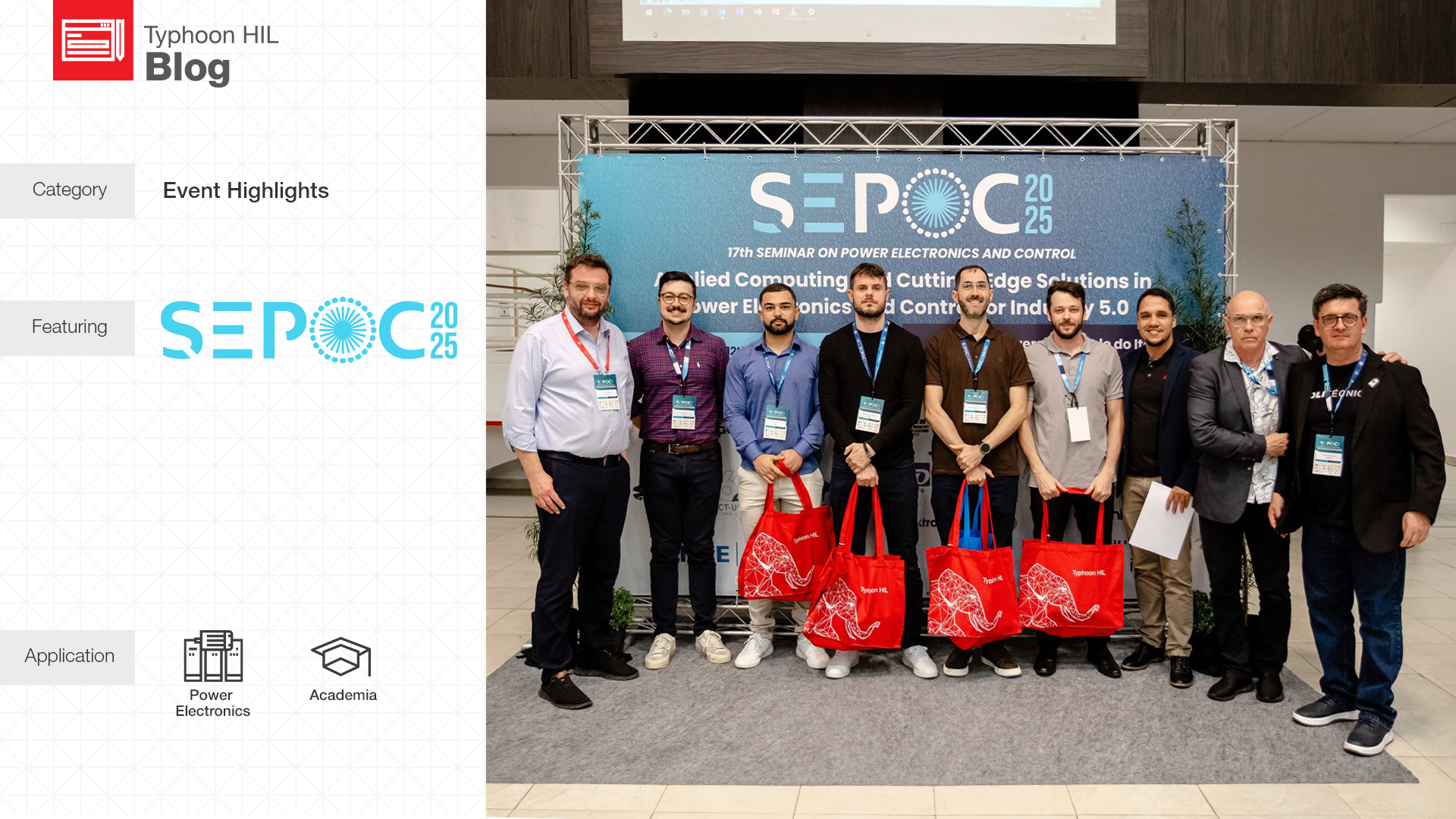
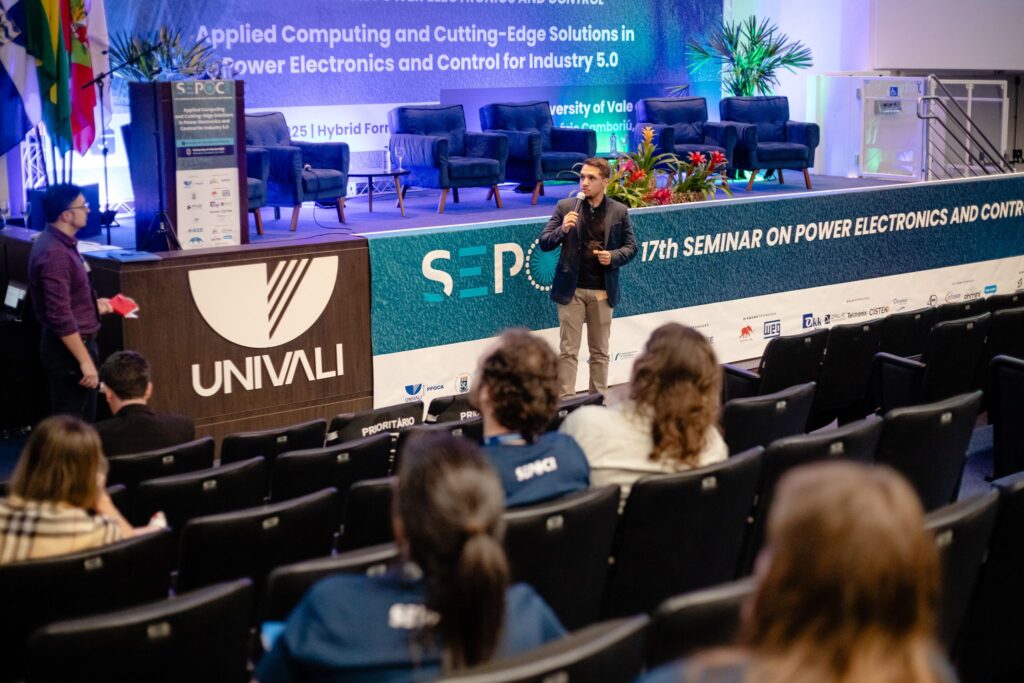
At the 17th Seminar on Power Electronics and Control (SEPOC 2025), held at the University of the Itajaí Valley (UNIVALI – Campus Balneário Camboriú) in Brazil, the Typhoon HIL Industrial Challenge brought together student and professional teams to tackle real-world problems in power electronics, control, and digital energy systems. Designed to promote hands-on adoption of model-based engineering (MBE), the challenge invited participants to develop, validate, and demonstrate innovative solutions by integrating TyphoonSim (offline simulation) and Hardware-in-the-Loop (HIL) simulation as fundamental components of industry-grade workflows.
The response was exceptional. Teams from universities and industry submitted comprehensive deliverables, including technical white papers (extended abstract), simulation models, and demonstration videos, showcasing how virtual testing environments can accelerate development while improving reliability and safety. Collectively, the solutions addressed key application areas such as renewable energy integration, power quality control, smart grids, and electrified transportation.
Competition Scope and Evaluation
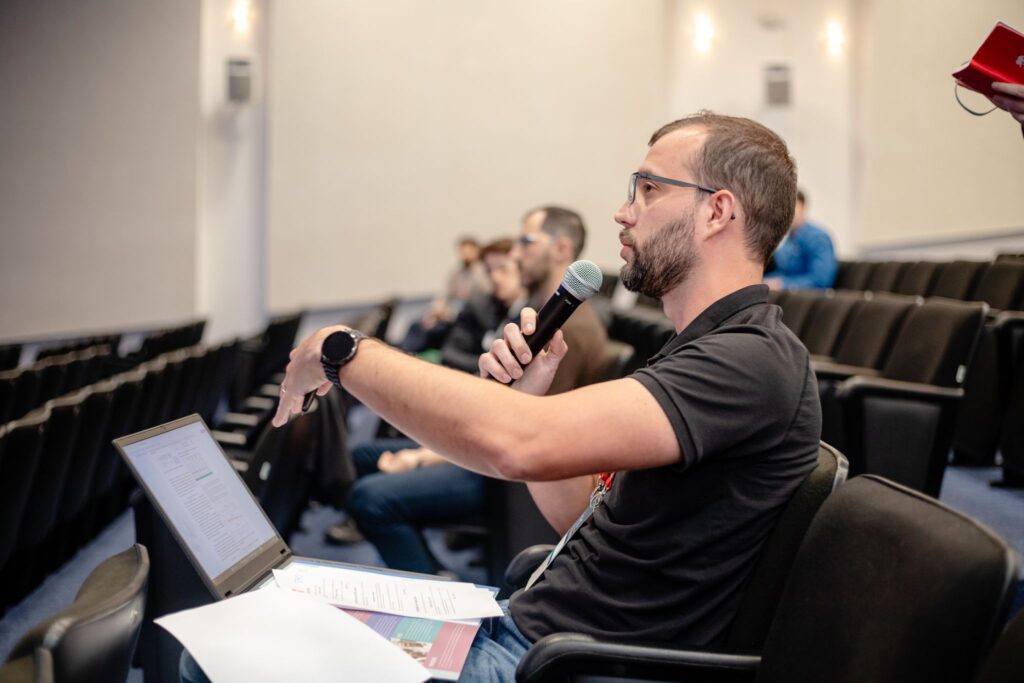
Participants were evaluated on technical depth, system modeling accuracy, and control performance using TyphoonSim. The strategic utilization of HIL-based validation was factored into the final assessment as supplemental points. Emphasis was placed on realistic system behavior, fault handling, and the ability to bridge simulation with control techniques. The challenge highlighted how simulation-based testing platforms enable rapid iteration, safe fault testing, and early-stage validation long before physical prototypes are available.
Winning and Finalist Solutions
First Place | SUPPLIER
The SUPPLIER team, representing Santa Catarina State University (UDESC – Campus Joinville), earned first place for a solution that demonstrated strong industrial relevance and disciplined system-level validation. While the challenge was based on TyphoonSim for offline simulation, the team secured a competitive advantage by extending their work into a real-time simulation environment. Their submission stood out for its effective application of control testing and model-based engineering, reflecting best practices aligned with modern digital power development.
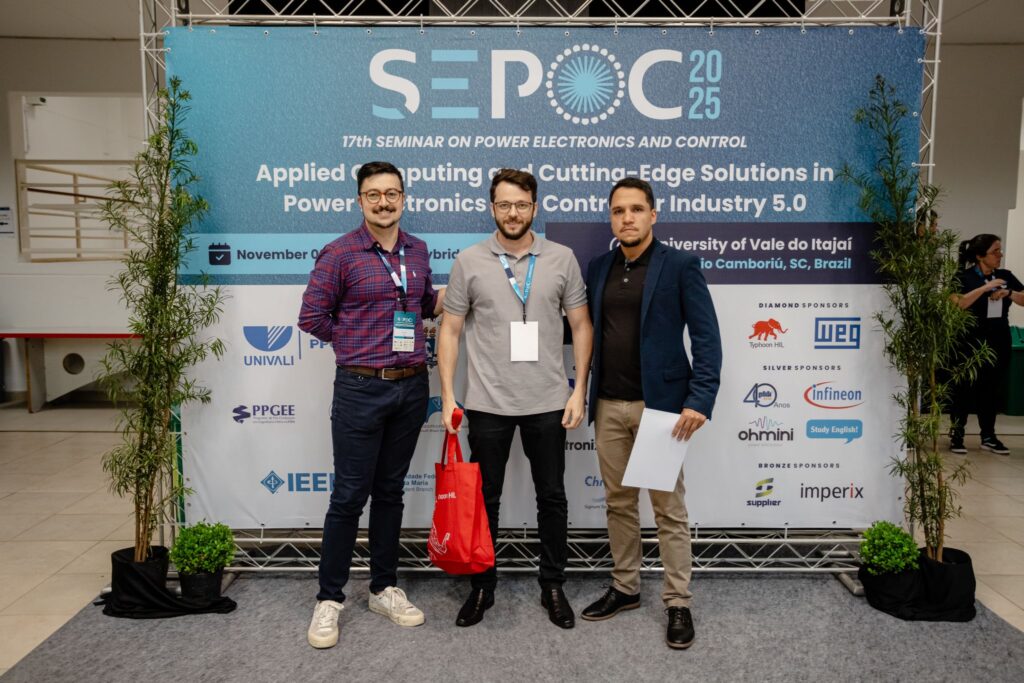
The winning team demonstrated a strong industrial perspective, focusing on system-level validation and controller behavior under realistic operating conditions. Their solution presents a configurable simulation developed in TyphoonSim for testing grid-tied inverters under the conditions specified by the IEC 61000-4-11 standard. The developed simulation consists of a grid-tied inverter utilizing a half-bridge topology with an LCL filter and a Proportional Resonant (PR) controller, synchronized through a Second-Order Generalized Integrator – Frequency-Locked-Loop (SOGI-FLL). A specialized Grid Reference Generator (GridRefGen), implemented in C-programming, was used to precisely generate the voltage dip and variation disturbance profiles required for IEC 61000-4-11 compliance testing. The simulation was extended into a P-HIL system using a Typhoon HIL’s HIL600 Simulator, AC sources, and photovoltaic simulators from SUPPLIER. The GridRefGen developed with TyphoonSim is used to control the SUPPLIER power amplifier. An automated testing platform with report generation was developed using TyphoonTest IDE. This approach ensures high repeatability in evaluating industrial compliance criteria, making it suitable for both industrial and research environments.
Second Place | G2 Power
With affiliations to Federal University of Santa Catarina (UFSC – Campus Blumenau) and São Paulo State University (UNESP), G2 Power presented a robust solution focused on a Type II digital current controller for a Multifunctional Grid-Tied Inverter (MFGTI). Their work demonstrated how TyphoonSim offline simulation is used to analyze Conservative Power Theory (CPT) current decomposition and validate tracking performance under diverse operating modes.
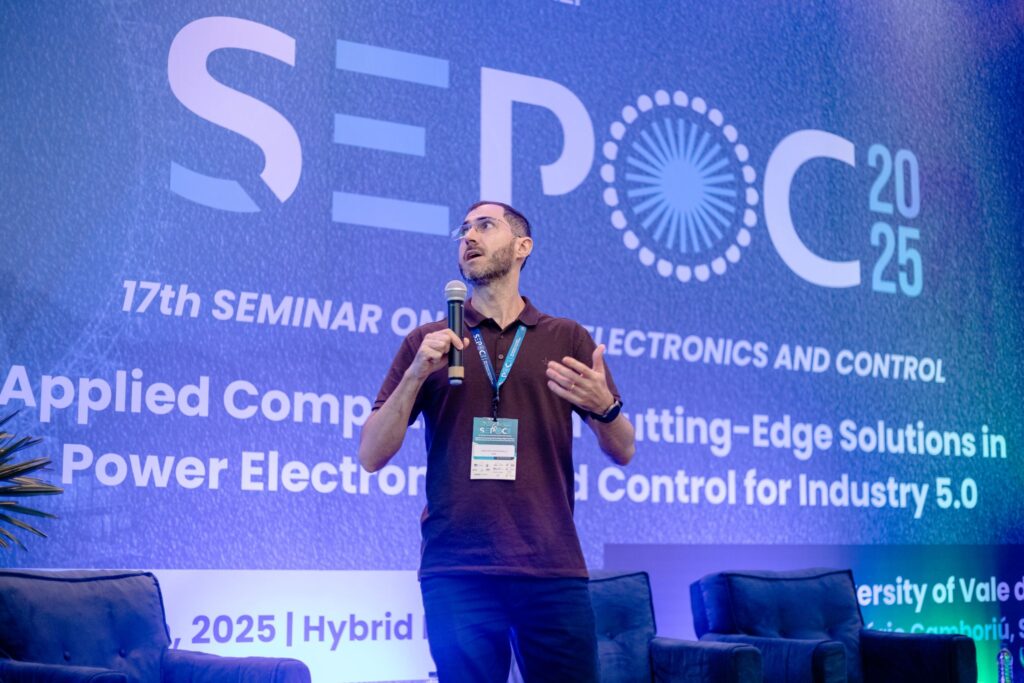
This submission centered on advanced control validation across a wide operating envelope, specifically utilizing CPT combined with a Phase-Locked Loop (PLL) to enable selective compensation of load disturbances. Their work showcased how simulation enables repeatable testing of active power injection, reactive compensation, and harmonic mitigation while maintaining close alignment between the Type II integral single-lead algorithm and plant behavior. The solution demonstrated a clear focus on robustness, scalability, and structured validation of DER integration.
Third Place | GESEP-UFJF
The GESEP-UFJF team, featuring members from the Power Electronics and Electrical Power Systems Research and Development Center (GESEP), including representatives from the Federal University of Juiz de Fora (UFJF), delivered a technically rigorous solution centered on a generic grid-following inverter framework for Power Plant Controller (PPC) optimization. Their approach highlighted the importance of real-time feedback and fault-aware validation, utilizing low-voltage and high-voltage ride-through (LVRT/HVRT) functionalities to ensure grid stability during disturbances. By employing an aggregated average inverter model with synchronous reference frame (dq) control, the team facilitated faster offline simulations and precise control gain tuning.
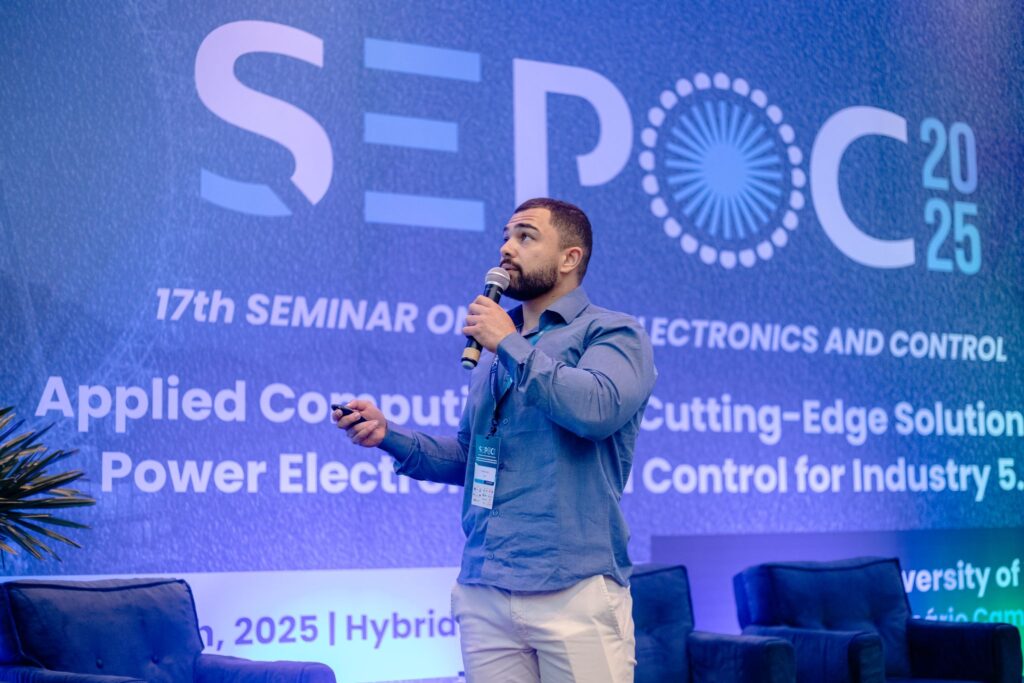
While the core challenge focused on offline modeling in TyphoonSim, this team achieved outstanding results by extending their work into real-time simulation. They implemented a sophisticated Controller Hardware-in-the-Loop (C-HIL) setup using the Typhoon HIL’s HIL606 device to validate a physical PPC. By integrating Modbus TCP/IP communication and comparing dynamic responses against PSCAD benchmarks, they demonstrated that their model ensures accurate active and reactive power reference tracking and regulatory compliance under real-world grid conditions.
Runner-Up Finalists | SmartPQC & LAFAE
Team SmartPQC from the Federal University of Santa Maria (UFSM) and team LAFAE, with members from The Federal University of Rio de Janeiro (UFRJ) and Rio de Janeiro State University (UERJ), were recognized as runner-up finalists for solutions addressing power quality, grid interaction, and adaptive control challenges. Both teams demonstrated strong use of simulation-driven design and provided compelling examples of how digital validation environments support smarter, more resilient power systems.
The SmartPQC team presented an automated controller design methodology fully integrated into the Typhoon HIL environment. The proposed approach is based on an offline data-driven optimization framework, in which Particle Swarm Optimization (PSO) minimizes an Integral of Time-weighted Squared Error (ITSE) cost function. This procedure enables the systematic tuning of the parameters of a general rational discrete-time controller Gc(z), resulting in optimized closed-loop performance and accurate current tracking in the alpha-beta reference frame. The entire design loop is implemented using Python and Typhoon Test IDE, emphasizing HIL-based automation for controller design.
The LAFAE team presented an Automated SMC Parametrization Optimizing Sliding Mode Control (SMC) via VHIL simulations to mitigate chattering and enhance dynamic performance. Utilizing a hybrid reaching law, the methodology minimizes settling time and DC voltage ripple in three-phase thyristor rectifiers. Performance indices are validated using TyphoonSim to ensure robust switching stability.
A Platform for Learning, Innovation, and Collaboration
Beyond rankings, the Typhoon HIL Industrial Challenge served as a collaborative learning platform. Participants gained practical experience with industrial-grade tools, reinforced theoretical knowledge through experimentation, and explored how HIL workflows translate academic concepts into deployable solutions. The diversity and maturity of the submissions underscored the growing role of digital twins, real-time simulation, and automated validation in modern power electronics engineering.
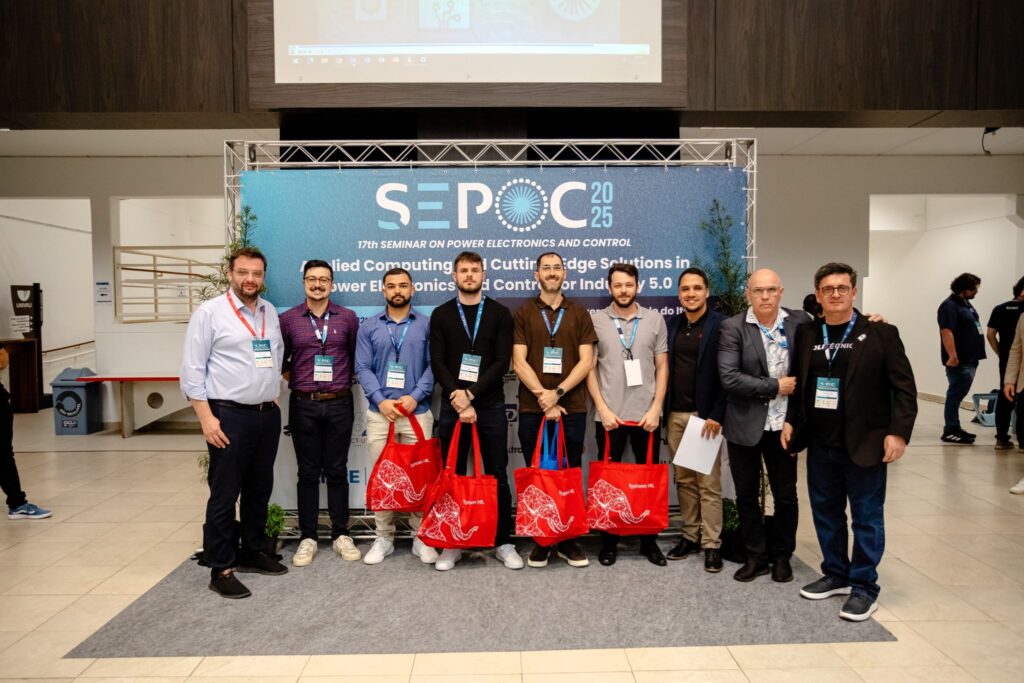
Typhoon HIL extends its sincere thanks to Prof. João Manoel Lenz for co-organizing the Industrial Challenge with us; to the SEPOC General Chair, Prof. José Renes Pinheiro; to the SEPOC General Co-Chair, Prof. Mauricio de Campos; and to the entire SEPOC organizing committee for hosting this Challenge. We also thank all participating teams for their outstanding contributions. A huge thanks goes to the evaluation committee: Prof. Denizar Martins, Prof. Humberto Pinheiro, Murilo Almeida, and Dr. Ivan Celanovic. The creativity and technical excellence demonstrated at SEPOC 2025 offer a strong glimpse into the future of digital power and control engineering.