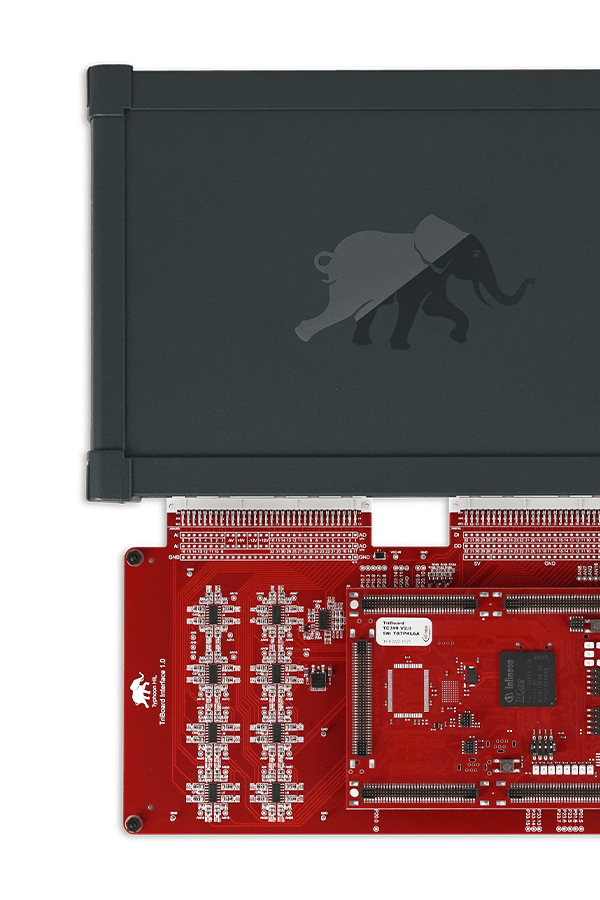
e-Mobility
HIL Testing Solutions
Drive Your e-Mobility Efforts Forward
Typhoon HIL is more than a testing solution—we’re your trusted partner in e-Mobility innovation. With deep expertise in real-time simulation and HIL testing, our vertically integrated platform and high-fidelity models drive the development and validation of EV powertrains, e-Drive systems, BMS, fuel cells, OBCs, EVSE, and DC/DC converters. Ensuring seamless interoperability across powertrain components, charging systems, and vehicle-to-grid technologies, we enable you to validate complex systems with precision and efficiency—long before hardware deployment.
Recognized for our rapid global delivery, dedicated engineering support, and hyper-personalized commissioning team, we provide the reliability and speed you need to bring your innovations to market with confidence.
Electric Powertrain
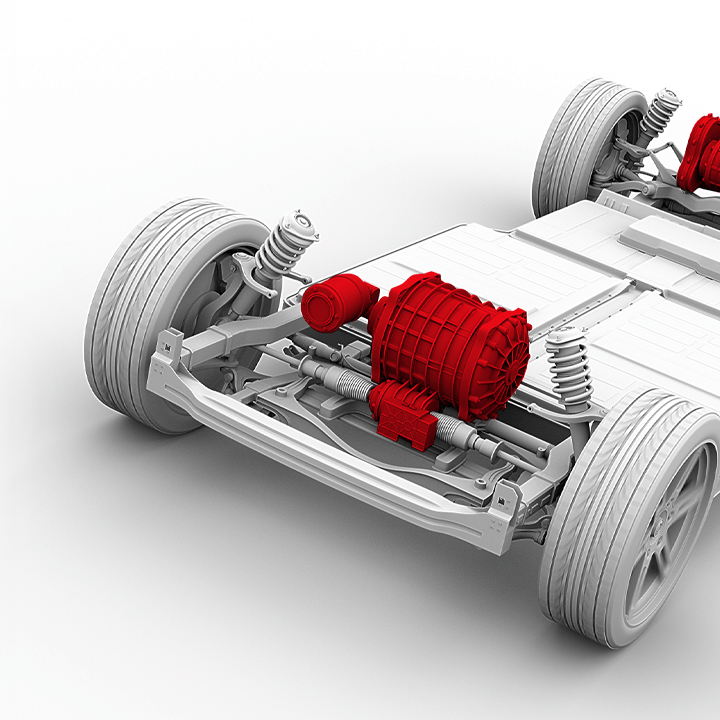
Is your company looking for more efficient and sustainable ways to design and test your electric powertrains and components? Typhoon HIL’s simulated solutions can manage all of your electric vehicle (EV) and e-Mobility testing and validation needs quickly and seamlessly. Built for HIL testing of electric powertrains, our solutions are:
- Down to 200ns simulation time step with 3.5ns digital oversampling
- Interfaces for existing system-level simulators and HIL test bench set-ups
- ASAM XIL compliance guaranteed integration with other automotive test tools
e-Drive
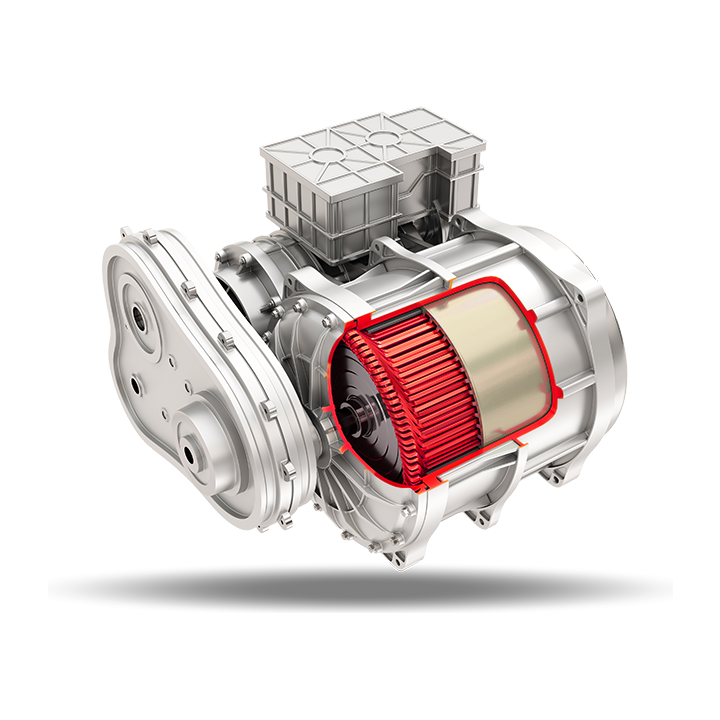
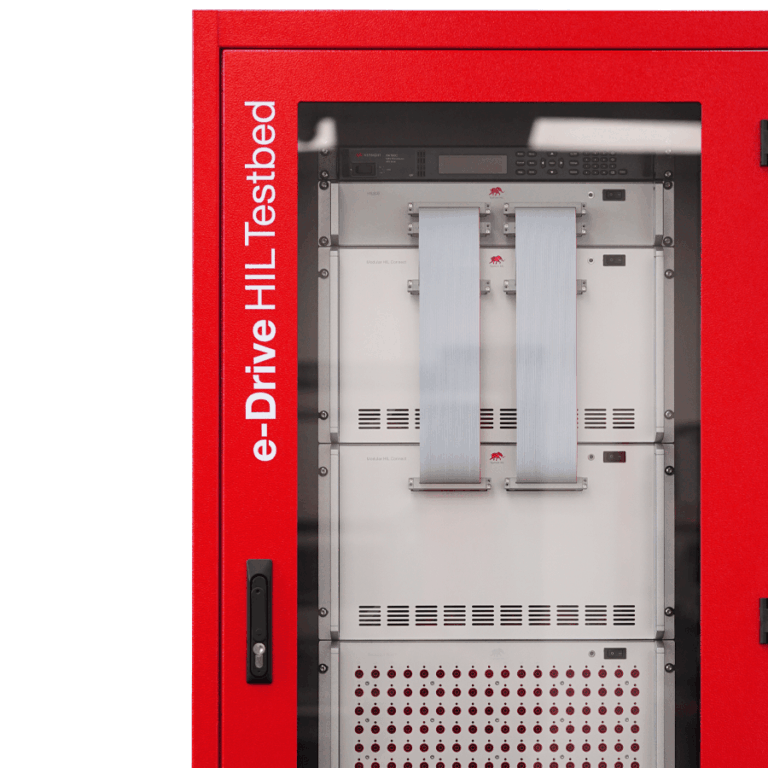
Automotive manufacturers today are under great pressure to find new ways to develop, test, and validate their high-performing electric drive units, despite shrinking budgets and shorter timeframes. If this sounds familiar, Typhoon HIL’s Hardware-in-the-Loop (HIL) solutions can help you overcome industry challenges to improve your testing processes by:
- Full test automation suite, with integration to DevOps processes
- Reduced lag time, so testing is optimized
- True plug-and-play HIL solution
Battery Management System
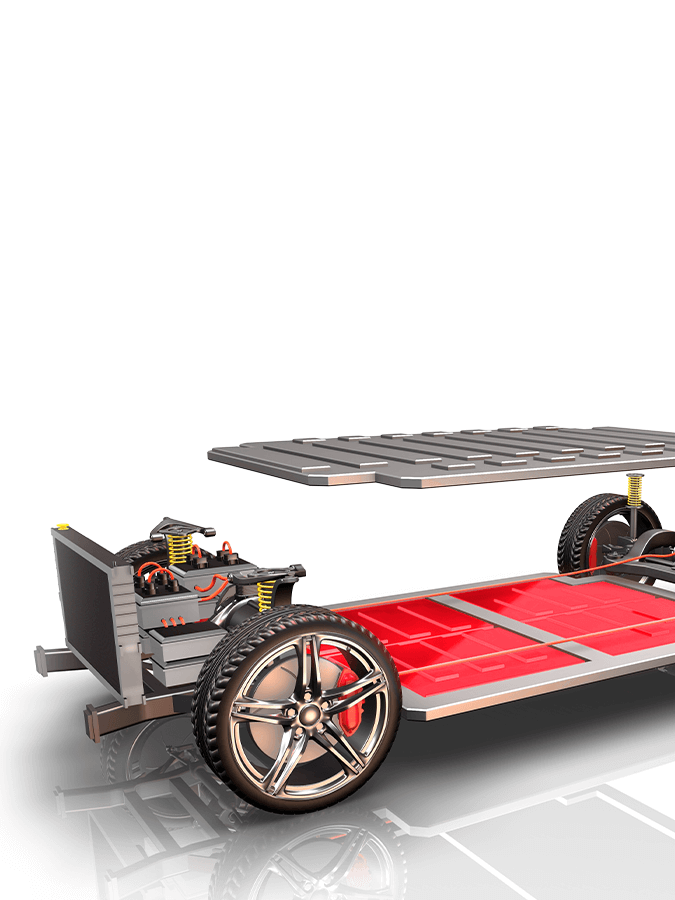
Our comprehensive toolchain makes it easy to ensure all of the components of your battery management system, controllers, and chargers are at peak performance. This is essential to maximize the lifespan and reliability of your EVs. Recreate a range of faults and errors and delays using our high-fidelity simulations to see how your battery management systems stand up in the real world, and make any changes needed to address any safety hazards proactively. Scale your BMS solution with:
- Cell model running on a real-time simulator with 16x cell emulator channels per box
- Modular design (easy to upgrade system simply by adding more boxes, no need for existing equipment modifications)
- Thermistor and isolation resistance emulators available
On-Board Charger
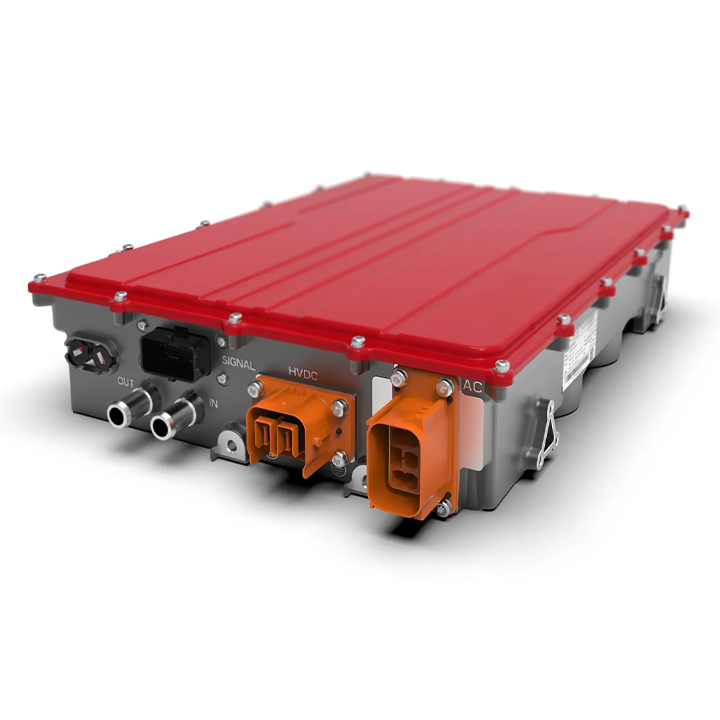
Your on-board charger (OBC) plays an essential role in powering your electric vehicles (EVs). Typhoon HIL’s specialized hardware enables your charger to communicate with a variety of external sources to convert AC energy into DC energy to charge your battery system. Our system makes it easy to simulate the charger components and switching capabilities in real-time in order to test these features in the virtual space and make sure they work under a range of conditions in the safest and most reliable way. Moreover, we support your team by:
- Testing for DC fast chargers, and electric vehicles OBC
- Early stage validation of control algorithms and communication protocols
- Simplifies the process of compliance testing with safety and communication standards, such as ISO 15118
- UltraCore Solver: precision real-time simulation of DC-DC OBC converters
EV Charging Stations
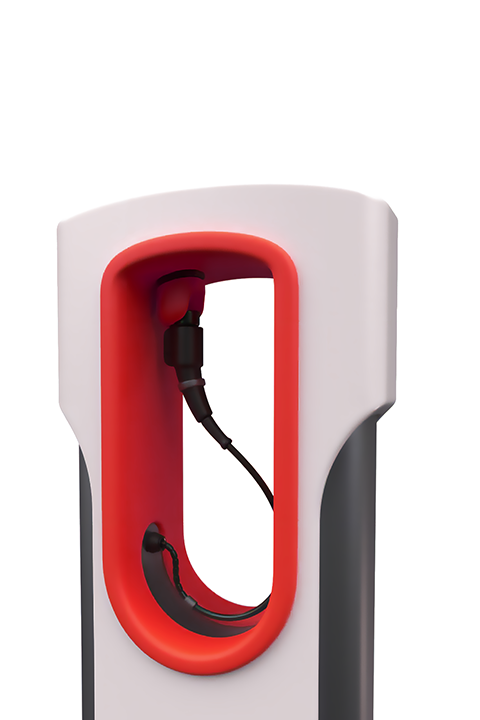
Typhoon HIL offers a cutting-edge simulated solution that makes it easy to test your charging station with your EV to ensure everything works together safely and efficiently. Our high-fidelity platform streamlines the process to help you optimize your charging station testing experience.
- DCDC converters simulated with 3.5 ns time step
- Validate communication protocols for different models of EVs and EVSE and test against existing charging standards
- Validate DC fast chargers interoperability with different EVs without the ISO 15118 implementation complexity
- Perform conformance tests in-house, avoiding certification failures and reducing development costs
- Test the integration of the V2G management system with the grid in real-time validating controllers and power converters for bidirectional power flow
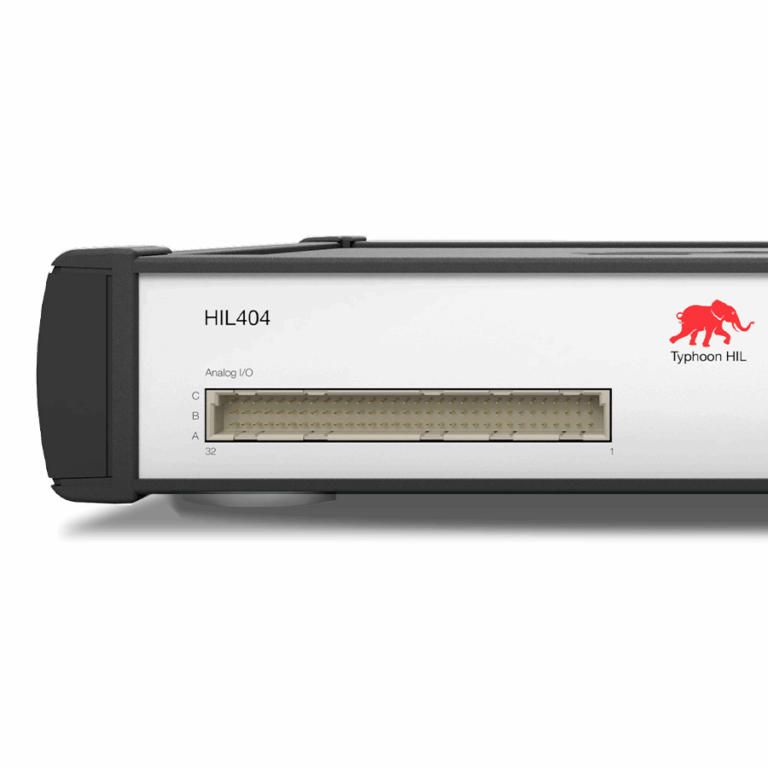
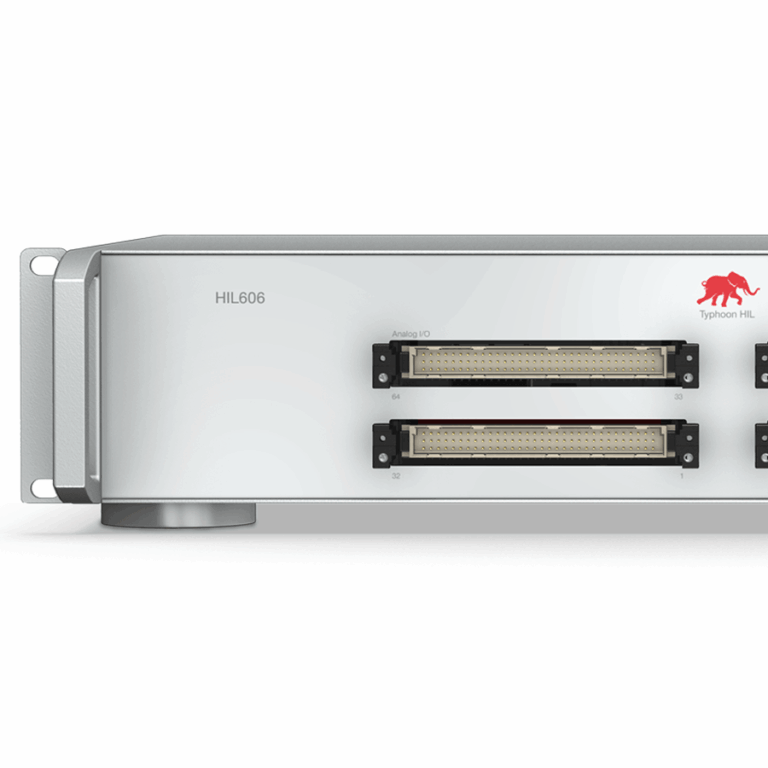
Explore Products for e-Mobility
Frequently Asked Questions
What is HIL testing for e-Mobility and electric vehicles?
Hardware-in-the-Loop (HIL) testing for e-Mobility connects a real EV controller under test — such as a powertrain controller, BMS, or OBC — to a high-fidelity real-time simulation of the electrical system it manages. The simulator replicates the behavior of the battery, motor, charger, and grid in real time, sending and receiving actual electrical signals to and from the controller. This allows engineers to validate firmware, test fault scenarios, and run compliance checks without physical hardware, dramatically reducing development time and the risk of costly late-stage failures.
How does Typhoon HIL support battery management system (BMS) testing?
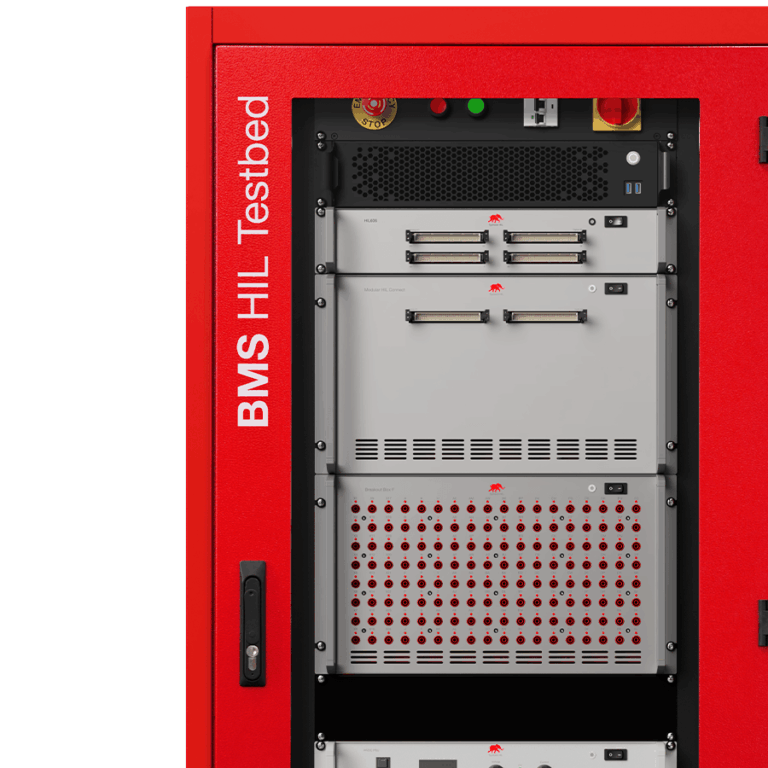
Typhoon HIL provides a dedicated BMS HIL testing solution that allows engineers to validate battery management system controllers across a full range of operating conditions and fault scenarios. The platform includes a real-time cell model simulator with 16x cell emulator channels per box, thermistor and isolation resistance emulators, and modular hardware that scales by simply adding units. Engineers can recreate cell faults, communication errors, thermal extremes, and isolation failures in simulation — validating BMS resilience safely and repeatedly before physical battery testing.
Can Typhoon HIL be used to test on-board charger (OBC) and EV charging station controllers?
Yes. Typhoon HIL supports HIL testing for both on-board chargers (OBCs) and EV charging station (EVSE) controllers. For OBCs, the platform enables real-time simulation of charger components and switching behavior, early validation of control algorithms, and compliance testing against standards including ISO 15118. For EVSE, Typhoon HIL enables end-to-end testing of AC and DC charging control systems, vehicle-to-grid (V2G) communication, and interoperability across vehicle types and power levels.
What is ASAM XIL compliance and why does it matter for EV powertrain testing?
ASAM XIL is an international standard that defines interfaces between test automation software and HIL systems, enabling seamless interoperability across tools from different vendors. For EV powertrain development teams, ASAM XIL compliance means that Typhoon HIL’s platform integrates directly with existing automotive test tools — such as test management systems, model-based design tools, and CI/CD pipelines — without custom integration work. Typhoon HIL guarantees ASAM XIL compliance, making it straightforward to incorporate HIL testing into existing automotive development workflows.
What e-Mobility HIL testbeds does Typhoon HIL offer?
Typhoon HIL offers turnkey HIL testbeds for e-Mobility applications, including the e-Drive HIL Testbed for electric drive unit validation and the BMS HIL Testbed for battery management system testing. These testbeds come ready-to-use with pre-built models, productized controller interfaces, and application-specific test libraries, enabling teams to get from zero to a working HIL setup in a single day through Typhoon HIL’s HIL in a Day service. Both testbeds are HIL Compatible®, meaning any OEM controller can be integrated in minutes.

Smooth Transitions, Reliable Results: The HIL Advantage
Model fidelity and seamless stage-to-stage transition are crucial in selecting a HIL provider. At Infinitum, we rely on high-fidelity HIL simulations to ensure our control algorithms will perform as expected on real hardware. The ability to explore different operating points, verify safety trip levels, and assess system efficiency before hardware testing gives us confidence in our designs. Developing our own motor drive control algorithms, we need a HIL system we can trust—and that trust is invaluable.