


Introduction
If you’ve ever built controls for power electronics, you know the painful part isn’t writing the first controller—it’s discovering the edge cases once real hardware shows up. In this article, we walk through how a grid-tied hybrid inverter control system (multiple PV inputs + energy storage + a four-leg three-phase inverter) was developed and verified using the Typhoon HIL’s HIL506 real-time simulator. The goal: validate power conversion, grid synchronization, and energy management early—so hardware bring-up is faster, safer, and far less surprising.
Key takeaways:
- Hardware-in-the-Loop (HIL) lets the real controller run against a high-fidelity, real-time plant model—before power hardware exists.
- Closed-loop HIL testing enables safe fault injections, rapid tuning, and deterministic timing validation—reducing schedule and integration risk.
- The Typhoon HIL platform enables rapid development and evaluation of control algorithms, thus significantly reducing schedule and integration risk.
The System at a Glance
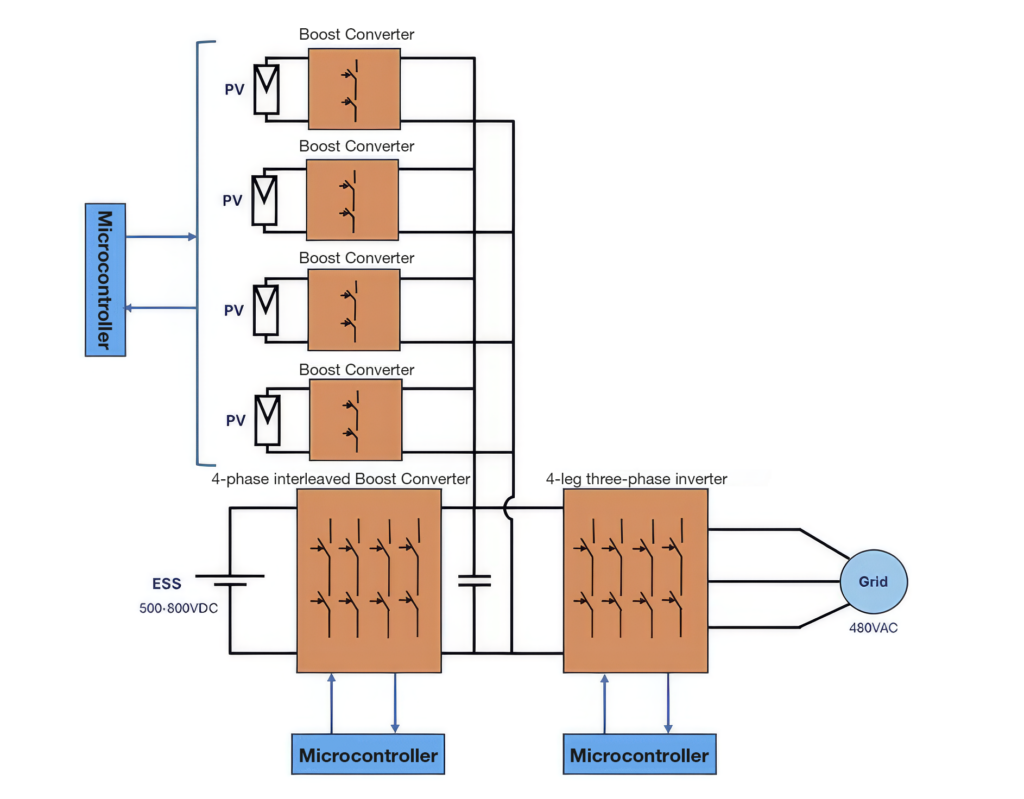
The project centers on a grid-connected hybrid inverter designed to coordinate three energy domains: photovoltaic (PV) inputs, an energy storage system (ESS), and the utility grid. The architecture (Figure 1) is intentionally modular and scalable, so each energy input can be controlled independently while still sharing common DC and AC interfaces.
On the DC side, each PV source feeds its own dedicated DC–DC stage. That one-per-source approach makes it easier to apply independent PV control (and, in future iterations, independent MPPT strategies) without the channels fighting each other. The outputs are then combined through an interleaved DC–DC conversion stage that regulates the shared DC bus and improves dynamic performance.
An ESS is coupled to the DC link to enable bidirectional power flow. In practice, that means the storage can absorb excess PV, smooth transients, and help balance power when grid or PV conditions change quickly.
On the AC side, a three-phase inverter provides full control of the grid currents. This is a strong fit for grid-tied and microgrid scenarios where robustness—and predictable current shaping—matters.
Control is partitioned across dedicated digital controllers: one set focused on DC-side conversion and energy management, and another focused on the AC-side grid interface.
With that split, teams can develop and test subsystems in parallel. The full power stage is modeled and executed in real time on HIL506, so the actual controller hardware can be tested in closed loop under realistic operating conditions—long before a high-power prototype is safe to energize.
Why Hardware-in-the-Loop Changes the Game for Controller Development
Offline simulations are great for getting started, but they often rely on simplified (or averaged) models that miss the real behaviors that break controllers in practice—timing quirks, saturation effects, nonlinearities, and messy grid events. That’s why teams frequently find the “interesting problems” only after hardware arrives.
With Typhoon HIL, the controller isn’t a simulated block—it’s the real target hardware, running the same firmware you intend to ship. That controller is wired to a real-time, high-fidelity simulation of the inverter, sources, storage, and grid. You get closed-loop behavior that’s much closer to reality, without the safety risk (or cost) of early high-power testing.
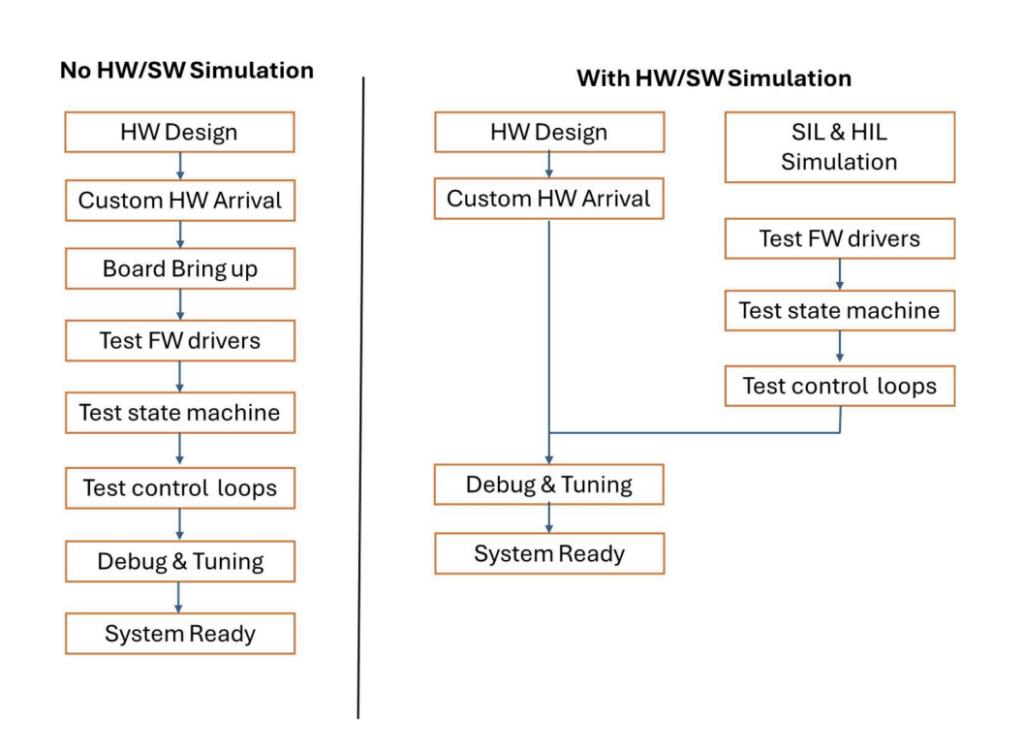
The biggest practical win is parallelization: hardware and software development no longer have to wait on each other. In this workflow (Figure 2), HIL supports:
- Earlier debugging of state machines, sequencing, and protections
- Fast iteration on control-loop tuning under repeatable conditions
- Safe testing of grid disturbances and fault cases
- Deterministic timing validation (the controller runs under real constraints)
How the HIL506 Setup Was Put Together
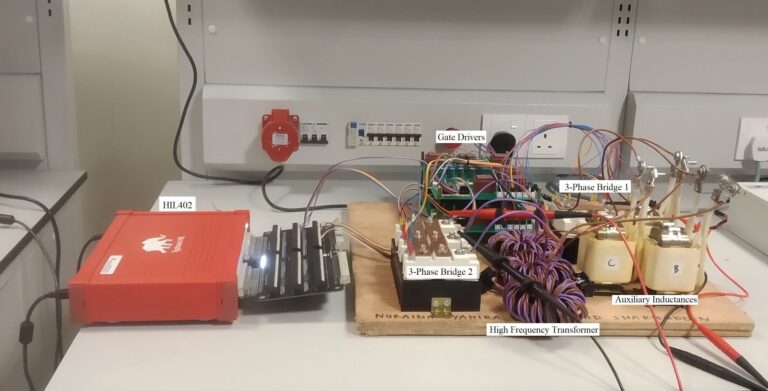
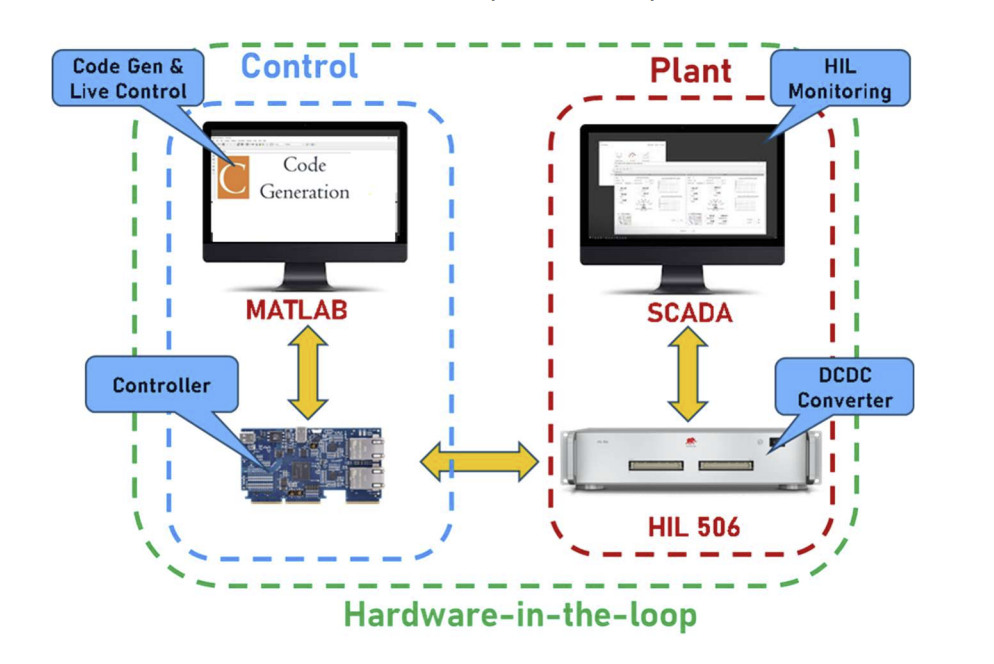
The hybrid inverter HIL setup was built around a simple idea: keep the controller and the plant clearly separated but connect them with real-time I/O so the closed loop behaves like the final system. Figure 3 shows the overall architecture used with Typhoon HIL’s HIL506.
Controller side: Control algorithms were created using a model-based design flow, prepared for code generation, and deployed onto the target controller hardware. This matters because it preserves real execution order and timing constraints—exactly the things that tend to differ between offline simulation and hardware.
Plant side: The power conversion stages (DC–DC front end and the grid-connected inverter) were modeled and executed in real time on the HIL506. Because the plant is simulated, internal variables and fast electrical dynamics can be monitored safely—without energizing high-power equipment.
Closed-loop interaction: The controller outputs gate commands and references to the real-time plant model, and the HIL returns simulated feedback signals (currents, voltages, states) back to the controller. This bidirectional loop enabled broad validation of control logic, protection, and system-level interactions across operating modes.
Net result: tasks that are usually sequential—firmware development, integration testing, tuning, and even fault validation—can start earlier and run faster. That improves development efficiency, lowers technical risk, and makes the eventual jump from HIL to prototype feel much more like a controlled step than a leap.
Wrap-Up
Using Typhoon HIL’s HIL506 system, the hybrid inverter controller could be developed and validated in closed loop with a real-time plant model—before committing risky, high-power prototype tests. The approach supported early verification of grid synchronization behavior, power-stage interactions, and protection logic under realistic (and repeatable) conditions, while also enabling safe fault testing.
– Jabil Renewables Design Engineering Team
The views and opinions expressed here are Jabil’s own and are based on our experience with Typhoon HIL’s HIL506; however, Jabil receives compensation from Typhoon HIL, Inc. for endorsing their HIL506.