

Introduction | NHOA Energy in a Nutshell
NHOA Energy is a global provider of utility-scale Battery Energy Storage Systems (BESS), delivering turnkey Engineering, Procurement, and Construction (EPC) projects as well as advanced system integration solutions that support the transition towards cleaner and more resilient power systems.
Operating across Europe, Australia, Asia and the Americas, the company combines proprietary technologies, including its Power Conversion System (PCS), Energy Management System (EMS) and Power Plant Controller (PPC), with deep expertise in plant integration to deliver high-performance energy storage solutions tailored to the specific requirements of each electricity market worldwide.
From engineering and manufacturing to commissioning and long-term operation, NHOA Energy manages the entire project lifecycle, helping utilities, independent power producers, and transmission system operators deploy reliable, bankable, and grid-compliant energy storage infrastructure internationally.
To ensure the highest quality standards and minimize commissioning risks, NHOA Energy continuously invests in advanced validation methodologies, including Control Hardware-in-the-Loop (C-HIL) testing. This approach allows the company to validate complex control architectures in a realistic digital environment before deployment in the field, significantly reducing project risk while accelerating delivery schedules.
Challenges | The BESS Project
BESS projects represent an excellent example of how digital validation can simplify delivery in highly complex utility-scale contexts.
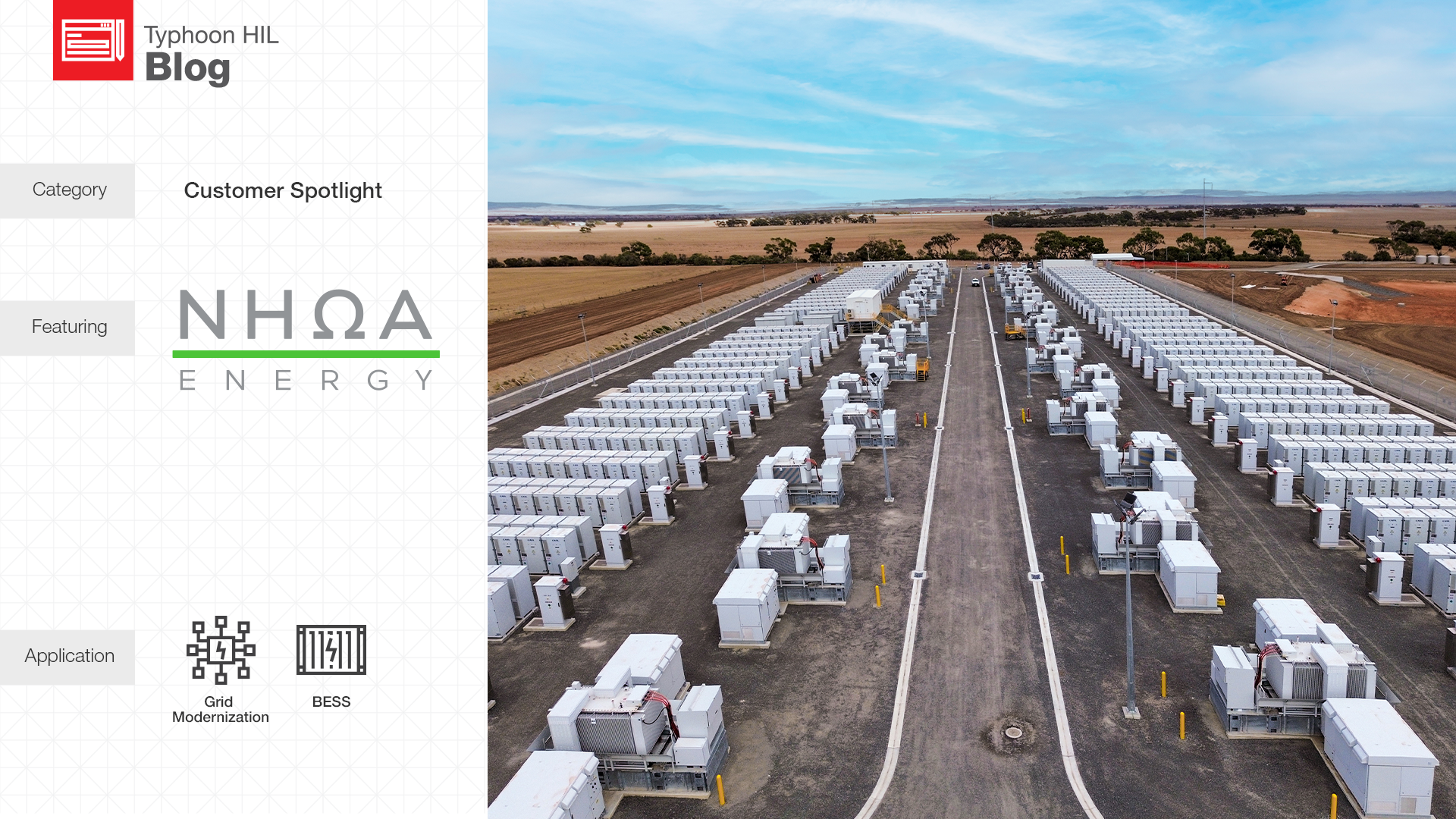
Delivered by NHOA Energy, located in Australia and connected to the National Transmission Network through an existing high-voltage (HV) substation, the presented battery project is a 2-hour storage plant, designed to support the grid through the following advanced functionalities:
- Frequency Control Ancillary Services (FCAS – P(f))
- Voltage Regulation Services (Q(V))
- SAIT RAS Service (Fast Reserve)
- Participation in Wholesale Energy Markets
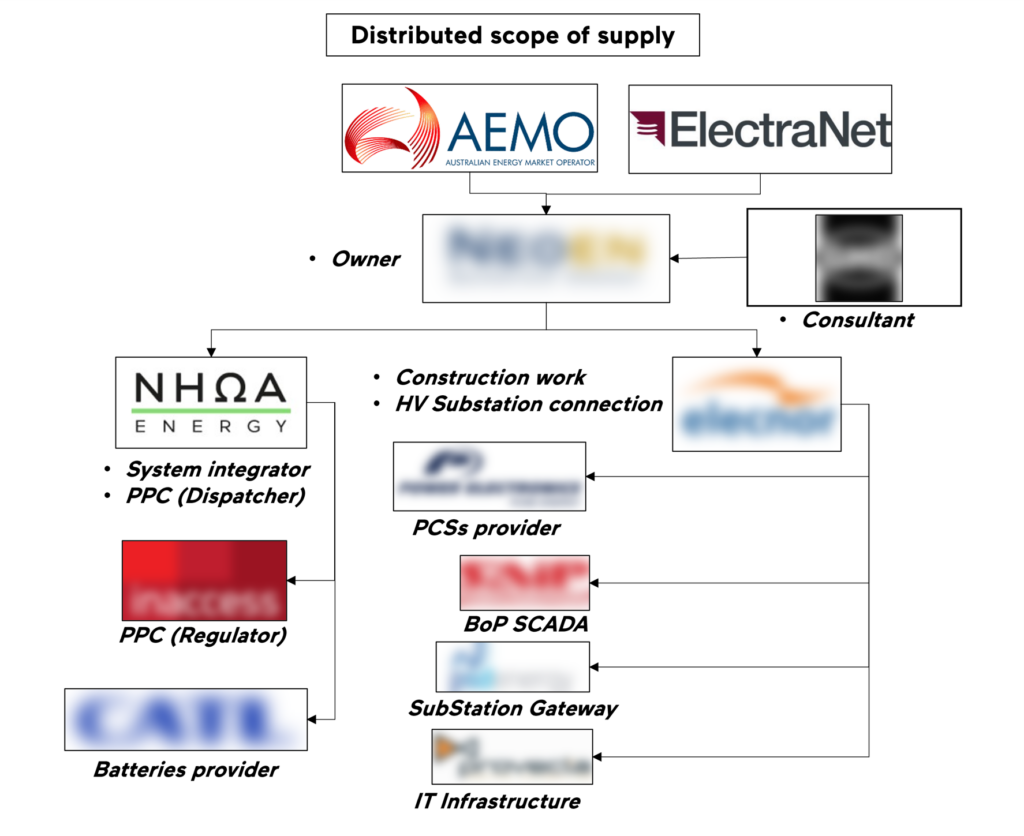
Like many large utility-scale BESS, the presented battery project was characterized by a complex organizational structure involving multiple stakeholders responsible for different aspects of engineering, construction, system integration, and grid compliance. Coordinating the following organizations (as depicted in Fig.1), while ensuring seamless interaction between their respective technologies, was one of the project’s primary technical challenges:
- The Australian network authorities involved are the Transmission Network Service Provider (TNSP, ElectraNet) and the Market Operator (AEMO), which oversee approval of the plant’s grid connection and act as the market interface for the plant owner.
- The owner, supported by an engineering consultant, commissioned the plant through a joint venture of EPC contractors.
- EPC Contractor 1 was responsible for site construction works and the HV substation connection. This contractor outsourced the supply of the Power Conversion Systems (PCS), Balance of Plant (BoP) SCADA, substation gateway, and IT infrastructure to several subcontractors.
- EPC Contractor 2 (NHOA Energy) was responsible for system integration and the supply of the Power Plant Controller (PPC) and battery systems.
The complexity and distribution of responsibilities across project stakeholders directly translated into a highly complex control-system architecture. Responsibility for controlling power exchange between the BESS and the grid, while ensuring compliance with grid-supporting service requirements, was distributed among multiple devices supplied by different project participants.
Specifically, the power-control chain is structured as follows (see Fig. 2):
- A grid-supporting service command is sent to the PPC regulator, either through the owner’s market system or via the TNSP interface.
- The PPC regulator processes the request and sends an aggregated power setpoint to the PPC Dispatcher (PEMS Core).
- The PEMS Core runs an online optimization algorithm to calculate PCS-specific setpoints and distributes them through an optical-fiber communication ring to each PEMS Battery generating unit.
- Each PEMS Battery unit receives its PCS setpoint, processes it, and forwards it to the PCS control board.
- The PCS control board processes the command and initiates power production.
- Finally, the PPC regulator reads the power feedback from the HV power meter (PQM) and adjusts the aggregated setpoint through closed-loop regulation.
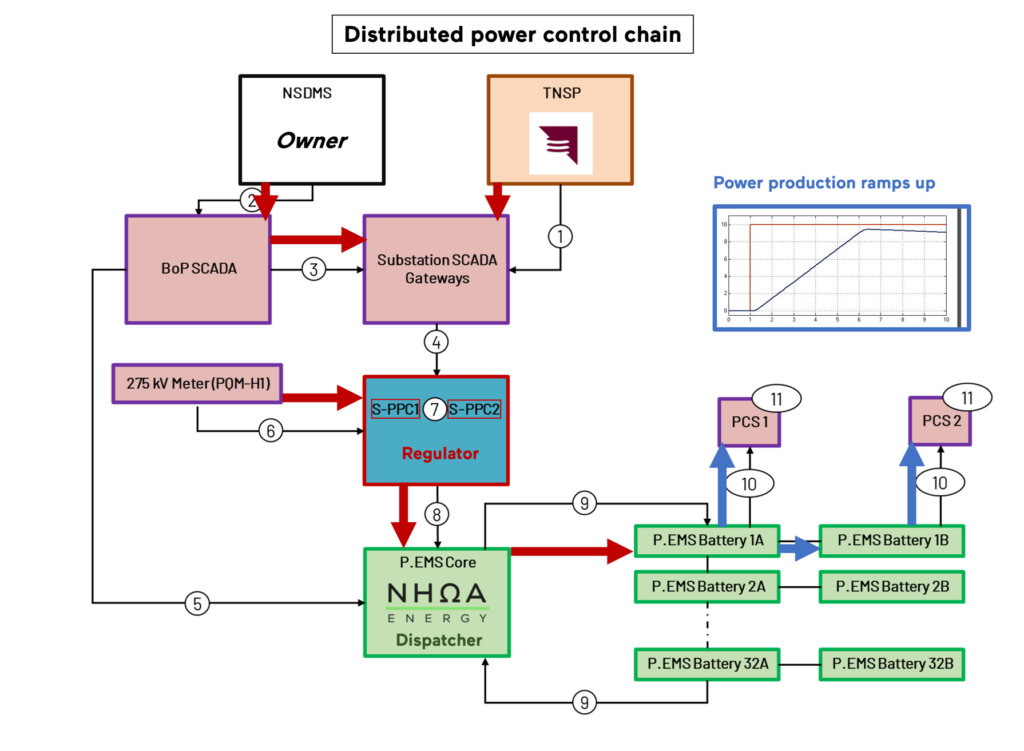
This type of distributed control chain introduces two major commissioning challenges:
- Multiple communication latencies are introduced at each control stage, potentially affecting overall control stability.
- Troubleshooting can be difficult due to the large number of interacting devices involved.
Identifying and resolving these issues only during on-site commissioning would significantly increase project risk, extend commissioning timelines, and require the close coordination of multiple suppliers in parallel, increasing coordination complexity and costs. For this reason, NHOA Energy sought to validate the complete control architecture in a representative digital environment before deployment.
Solution | C-HIL Studies with Typhoon HIL
Compared with standard Model-in-the-Loop (MIL) or Software-in-the-Loop (SIL) approaches, Control Hardware-in-the-Loop (C-HIL) enables the assessment of multiple real Devices Under Test (DUTs) integrated in a closed loop with the same high-fidelity real-time simulation, effectively creating a digital twin of the BESS plant.
To de-risk complex projects and improve delivery quality, NHOA Energy leveraged a C-HIL test bench integrating all relevant control hardware, including NHOA Energy equipment (redundant PEMS Core and PEMS Battery units), as well as third-party equipment such as the PPC regulator, PCS control board, and power meter.
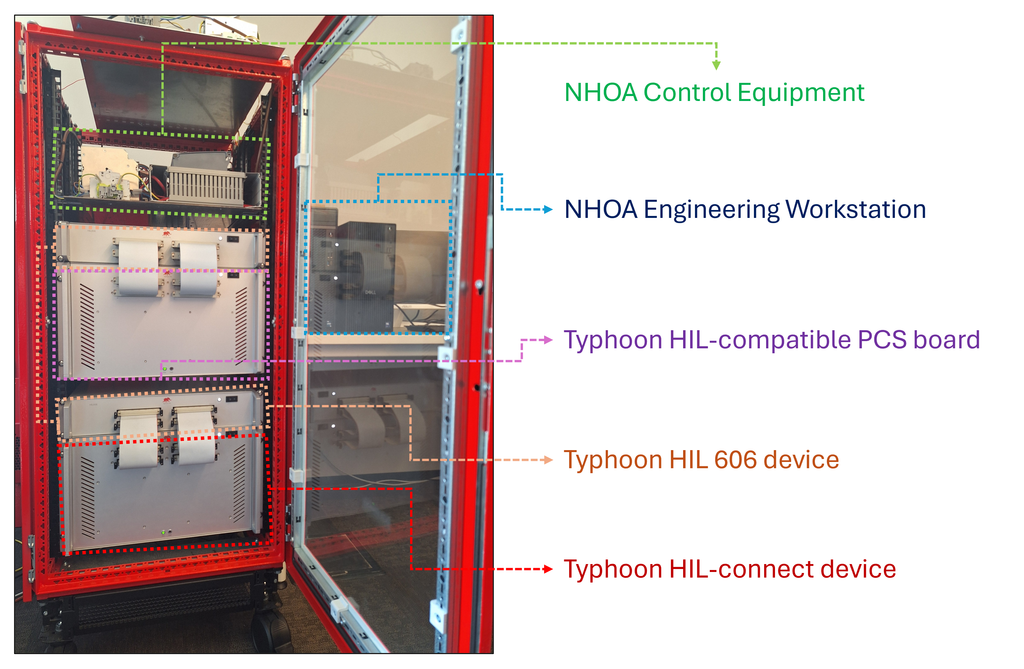
The test bench featured two Typhoon HIL flagship HIL606 devices for parallel execution of the partitioned electrical model and a HIL Connect device for interfacing the real-time simulation with the power meter through amplified analog signals (see Fig. 3).
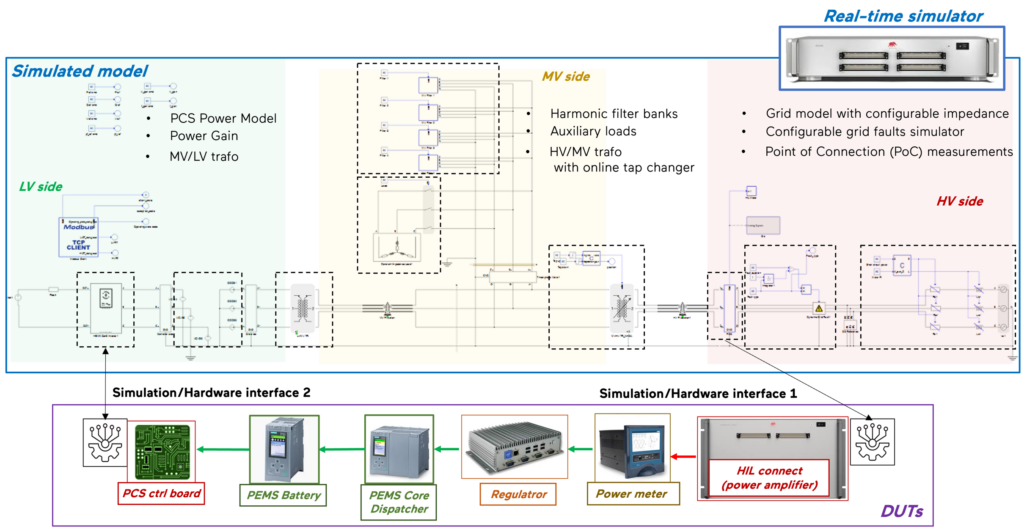
To model a grid-connected BESS in the Typhoon HIL Schematic Editor environment, NHOA Energy adopted a single-PCS parametric approach in which only one generating unit (PCS) is connected on the low-voltage (LV) side (see Fig. 4). A power gain block scales the power generated by the single PCS to match the output required for the entire plant.
An MV/LV transformer connects the LV side to the medium-voltage (MV) side, where harmonic filters and auxiliary loads are modeled. An HV/MV transformer equipped with an online tap changer connects the MV side to the high-voltage (HV) side, where the grid model, configurable grid impedance, grid-fault simulator, and Point of Connection (PoC) measurement signals are implemented.
An adjustable scaling factor enables rapid recompilation of the same model to represent different numbers of active PCS generating units. Transformer losses, auxiliary loads, and, where necessary, grid impedance are automatically rescaled accordingly. This modeling strategy makes it possible to evaluate control-system performance across different operating conditions and power-production levels.
To control the grid-connected BESS model in real time, a Typhoon HIL SCADA panel (as represented in Fig. 5) provides direct, high-fidelity communication with the PCS control board (Modbus TCP) and the PPC (DNP3). It also enables interaction with electrical quantities and plant components, including harmonic-filter and auxiliary-load disconnectors, HV/MV tap-changer position, and grid waveform and impedance parameters.
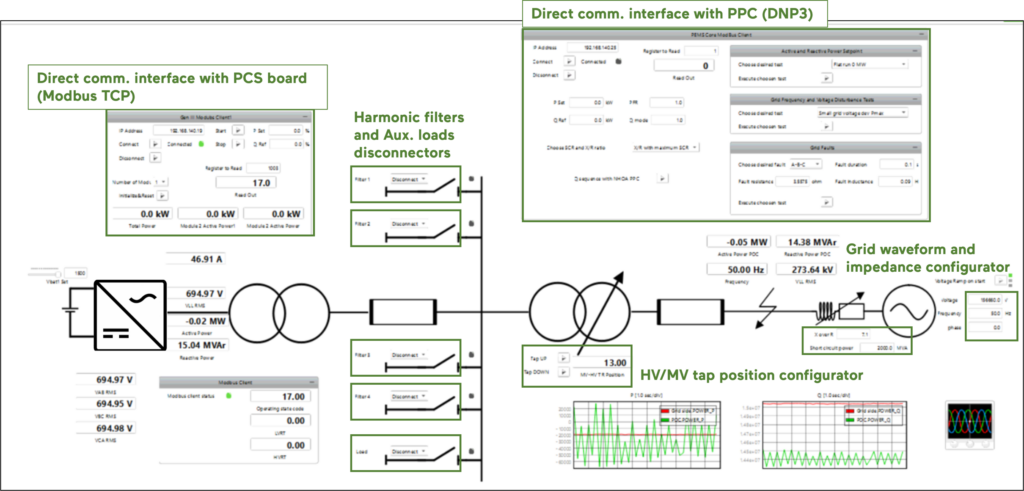
NHOA Energy leveraged this digital twin of the grid-connected BESS to fine-tune the entire distributed control architecture and ensure control stability and compliance with grid-code requirements before commissioning activities began on site.
This approach enabled the team to identify and address most system criticalities in advance, significantly accelerating the overall delivery process.
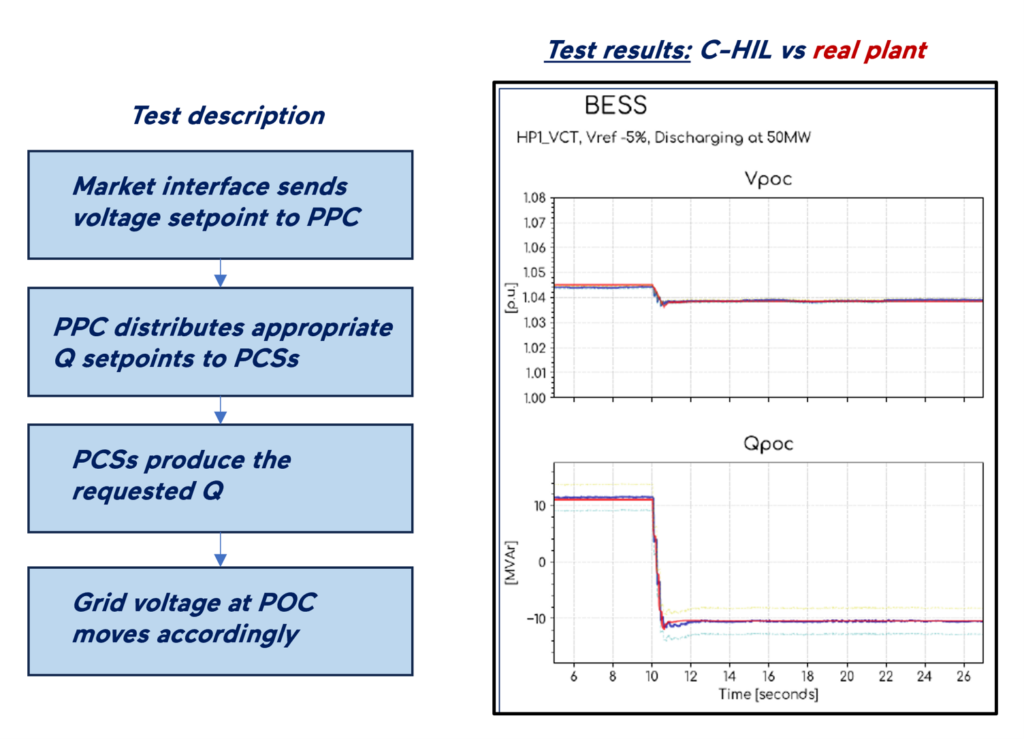
Benchmark comparisons between the response of the real plant, measured during official site acceptance tests, and C-HIL simulation results demonstrated a high degree of correlation in both transient response and steady-state accuracy. These results ultimately validated the fidelity of the BESS digital twin (see Fig. 6).
HIL Benefits | Conclusions and Take-Home Messages
Typhoon HIL-powered BESS digital twins enable NHOA Energy to anticipate project criticalities and predict system performance with a high degree of fidelity, accelerating grid connection and improving project delivery quality.
The benefits extend well beyond project delivery. NHOA Energy continues to leverage this technology after system deployment to safely evaluate and implement client change requests, as well as replicate and troubleshoot issues observed in operating plants. As a result, this technology has become a key enabler of NHOA Energy’s continuous innovation capabilities and commitment to service excellence.
This capability allows engineering teams to continuously improve plant performance while minimizing operational risks for customers.
C-HIL testing powered by Typhoon HIL has become an essential driver of innovation at NHOA Energy, helping us accelerate development, master challenging operating conditions, ensure grid compliance, and bring reliable BESS solutions from simulation into real-world operation.
Stefano Pane
Control Systems Engineer
NHOA Energy